Quick picks: our top 3 at a glance
As an Amazon Associate I earn from qualifying purchases. Prices and availability change.

Label printers have become essential for small businesses, home offices, and anyone tired of handwriting shipping labels. With so many models claiming fast speeds, wireless support, and compatibility with major platforms, it can be hard to tell which one actually fits your workflow. Some prioritize Bluetooth convenience, others focus on high-volume desktop use, and a few offer a balance of both. In this guide, we compare 8 label printers available as of November 2026 to help you decide based on your space, device, and labeling needs. If you’re also looking to tame cord clutter around your desk, check out our best cable organizers.
At a Glance
| Product | Brand | Rating | Key feature | Where to buy |
|---|---|---|---|---|
| JADENS Bluetooth Thermal Shipping Label Printer, Wireless 4×6 Label… | JADENS | 4.4 / 5 | [HIGH TECH LABEL PRINTER] Equipped with a Japanese high tech thermal print head, 2… | View on Amazon |
| Rollo USB Shipping Label Printer – Commercial Grade 4×6 Thermal Pri… | Rollo | 4.6 / 5 | ROLLO PRINTER: Rollo USB is compatible with both Windows (XP and newer) and Mac (1… | View on Amazon |
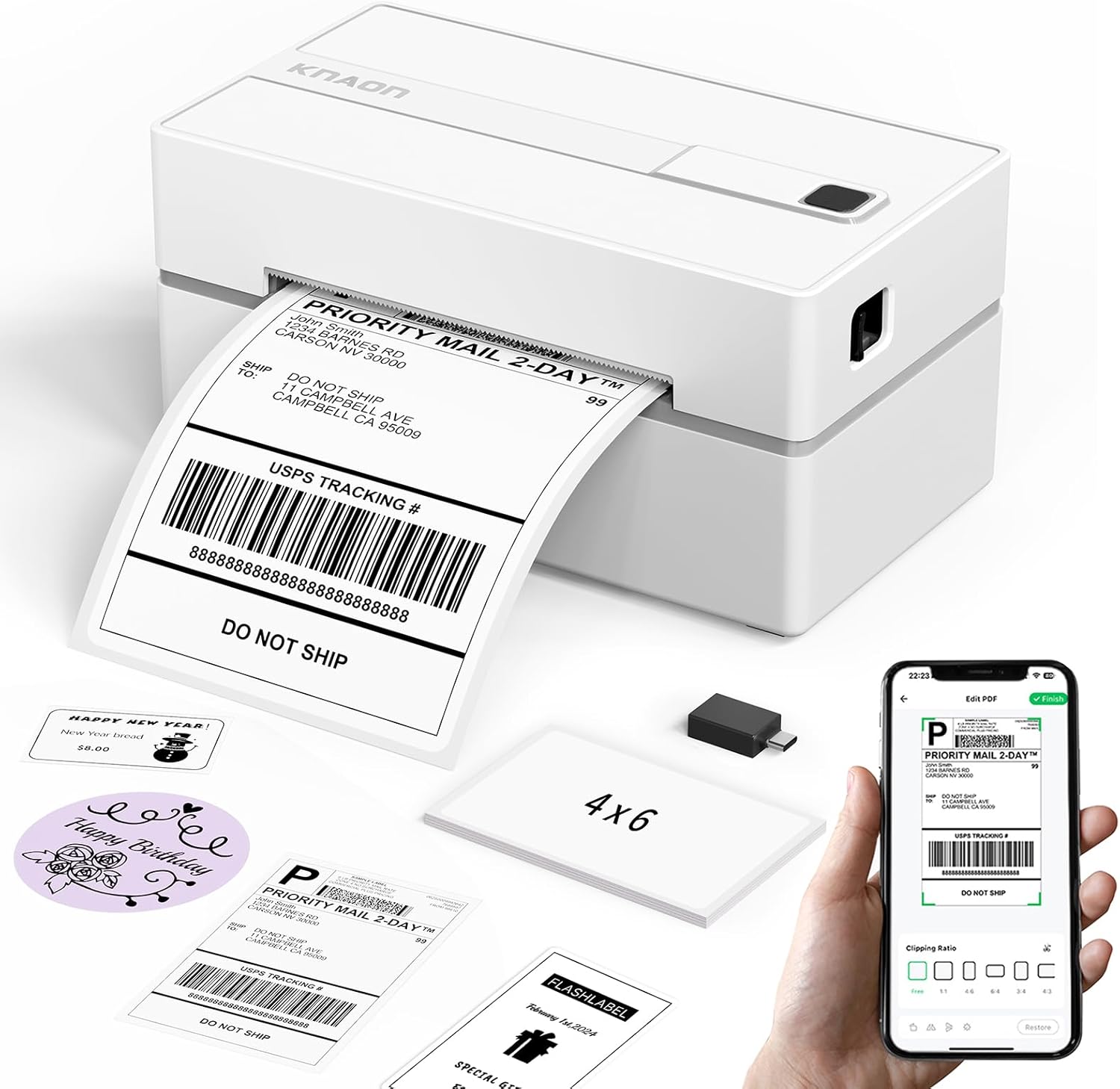
| KNAON Bluetooth Thermal Shipping Label Printer, 4×6 Portable Therma… | KNAON | 4.4 / 5 | Bluetooth Wireless Connection: KNAON Bluetooth shipping label printer enables wire… | View on Amazon |
| Phomemo Bluetooth Thermal Label Printer, 241BT Label Printer & 20Pc… | Phomemo | 4.4 / 5 | [Print Wirelessly] – Phomemo bluetooth shipping label printer supports wireless pr… | View on Amazon |
| Nelko Bluetooth Thermal Shipping Label Printer, 4×6 Thermal Label P… | Nelko | 4.3 / 5 | Go Wireless by Bluetooth: Download the "NELKO"app to print via Bluetooth on your N… | View on Amazon |
Ratings come from the Amazon listings when we last checked and can change.
Pros
- Ink-free thermal printing saves money
- Easy Bluetooth setup with Windows and Mac
- Compatible with major shipping platforms
- Compact size fits small workspaces
- Reliable customer support and warranty
Cons
- Phone app required for iOS/Android printing
- Must recalibrate when changing label sizes
- Limited to monochrome output
Pros
- No ink or toner required
- Prints one label per second
- Works with major shipping platforms
- Easy USB setup on Windows and Mac
- Supports custom label sizes
Cons
- Wired USB only, no wireless option
- Monochrome printing only
Pros
- Wireless printing from phone or computer
- Works with Etsy, Shopify, USPS, and more
- Compact and easy to store
- Fast printing up to 180 mm/s
- Supports multiple label sizes
Cons
- Requires FlashLabel Pro app for Bluetooth printing
- ChromeOS needs an additional extension to print

Pros
- No ink or toner required
- Bluetooth and USB connectivity
- Works with eBay, Shopify, Amazon, and more
- Fast 150 mm/s print speed
- Easy app-based mobile printing
Cons
- Monochrome printing only
- Recommended for use with Phomemo brand labels

Pros
- No ink or toner needed
- Wireless Bluetooth and USB connectivity
- Compact size saves desk space
- Fast printing for shipping labels
- Wide platform and label size compatibility
Cons
- Mac OS supports USB only, not Bluetooth
- Requires app for Bluetooth connection

Pros
- Bluetooth and USB for flexible connectivity
- High-resolution barcodes and graphics
- Automatic cutter saves time
- Large template library for business use
- Easy one-touch formatting and preview
Cons
- Uses proprietary TZe tape only
- Label width limited to 1 inch
- Bulky footprint for a label maker

Pros
- Bluetooth and USB connectivity
- Ink-free thermal printing
- Wide platform compatibility
- Compact and portable design
- Includes starter labels and cables
Cons
- Only available in pink
- Requires calibration when changing label size

Pros
- Fast 110 labels per minute
- Multiple connectivity options (Bluetooth, Wi-Fi, Ethernet)
- Standalone operation with LCD screen
- No ink or toner required
- Optional battery for mobile use
Cons
- Monochrome printing only
- Maximum label length 3 feet
Before buying a label printer, it helps to understand a few key factors that separate office-friendly models from compact travel companions. Here are the features that matter most.
Printing Technology: Thermal vs. Ink
All the label printers on our list use direct thermal printing, which means no ink or toner cartridges. This keeps operating costs low and maintenance minimal. The trade-off is that thermal labels are monochrome (black on white or black on colored paper) and can fade if exposed to heat or direct sunlight over many years. For shipping labels and short-term inventory tags, thermal is the practical choice.
Connectivity: Bluetooth, USB, Wi-Fi
How you connect your label printer to your computer or phone determines how easy it is to use. Most modern label printers offer Bluetooth for wireless printing from iPhone and Android, while others rely on a USB cable for a stable connection with Windows or Mac machines. Some high-end models include Ethernet or Wi-Fi for network sharing. If you print from multiple devices or move around a lot, a Bluetooth model saves hassle. For a single dedicated workstation, a USB connection may be more reliable.
Label Size and Type
Most shipping label printers accept 4×6 inch labels, which are standard for USPS, UPS, and FedEx. But if you need smaller labels for address stickers, name tags, or barcode labels, check whether the printer supports continuous rolls or pre-sized die-cut labels. Some models, like those from Brother, use a proprietary tape system that offers many widths, while others are designed strictly for 4×6 shipping labels.
Print Speed
Speed is measured in inches per second (ips). Faster models print a 4×6 label in under a second or two, which adds up when you have dozens of orders. Slower models may take a few seconds longer per label. For low-volume home use, speed is less critical, but for daily shipping, a faster printer saves real time.
Compatibility with Software and Platforms
Check that the label printer works with the apps and marketplaces you use: Amazon, Shopify, Etsy, USPS, eBay, and others. Many thermal printers are plug-and-play with these platforms, but some require proprietary software or driver downloads. If you use a Mac, verify support for macOS, as some budget models only support Windows out of the box. For a more organized setup, pairing a label printer with a USB-C hub can simplify desk connections.
Portability and Footprint
If you ship from different locations or have a small desk, consider the printer’s size. Compact models around 7 to 10 inches wide fit easily on a shelf or in a bag. Larger units may have a built-in cutter or larger paper roll capacity but occupy more counter space. Portability also matters if you want to move the printer between home and office.
Build Quality and Durability
While all the printers on our list are generally reliable, some have sturdier enclosures and better paper handling mechanisms. If you print frequently, a commercial-grade model with a metal frame may last longer. For occasional use, a plastic body is fine. Look for user reviews that mention jamming or alignment issues over time.
Why You Should Trust Us
Our recommendations are based on comparing available specifications, features, and real-world use cases for each label printer. We examine connectivity options, label compatibility, print speed, platform support, and documented customer feedback to identify meaningful differences. We do not claim to have physically tested every unit; instead, we rely on verifiable product details and practical buyer considerations to help you make an informed choice.
Final Thoughts
If you need a reliable everyday label printer that works with major shipping platforms and offers fast, crisp output, the High Speed Label Maker for Small Businesses from our list combines speed with a proven track record. For those who want a more affordable wireless option without sacrificing quality, the Compatible with Android, iPhone, Windows & Mac printer offers broad device support at a lower cost. And if your priority is a compact, Bluetooth-friendly model that travels well, the KNAON Bluetooth Thermal Shipping Label Printer is a strong candidate for on-the-go labeling.
No matter your setup, the best label printer is one that matches your volume, device ecosystem, and label size needs. If you’re also organizing your workspace, see our best cable organizers for desk management ideas.
Frequently Asked Questions
Do label printers require ink or toner?
Most modern label printers for shipping use direct thermal technology, which requires only heat-sensitive paper. No ink cartridges or toner are needed, making them cost-effective over time.
Can I use any thermal label paper?
Not all label paper is the same. Check the roll dimensions (typically 4×6 inches for shipping) and core size. Some printers require specific paper width or label spacing to avoid jams. Stick to recommended rolls for best results.
Will a label printer work with my Mac or Chromebook?
Most thermal printers support Windows and macOS, but drivers for Chromebooks are less common. Check the product description for specific OS support. Bluetooth models often work natively with Android and iOS devices.
How fast do label printers print?
Speed varies from around 2 to 8 inches per second. Faster printers are better for high-volume shipping. For occasional home use, speed is less critical.
Can I print small address labels on a shipping label printer?
Some printers accept smaller label rolls or allow you to print multiple labels per page using software. But if you primarily need small labels (like 1×2 inch), a dedicated label maker like the Brother P-Touch series may be more convenient.
Are wireless label printers reliable?
Bluetooth and Wi-Fi label printers are generally reliable within the typical range of 30 feet indoors. Interference from walls or other electronics can occasionally cause disconnections, but most modern models reconnect quickly. For mission-critical use, a wired connection is still the most stable.
How long do thermal labels last?
Direct thermal labels are sensitive to heat, light, and friction. Stored in a cool, dark place, they can remain legible for several years. For long-term archiving, consider synthetic labels or a thermal transfer printer.
What is the difference between a shipping label printer and a general label maker?
Shipping label printers are designed for high-speed 4×6 inch thermal labels used by carriers. General label makers (like those from Brother) are more compact and print on smaller, often adhesive-backed tape in various widths. Choose based on your primary use: shipping or organization.
Can I use a label printer for barcode labeling?
Yes, many thermal printers support barcode generation through included software or integrated with inventory management systems. Look for a model that supports USB or Bluetooth if you plan to print from a barcode app.
What is the best label printer for small businesses in 2026?
The best label printer depends on your volume and workflow. For high-speed, reliable 4×6 shipping labels, the Rollo High Speed Label Maker is a popular choice. If you need wireless printing on a budget, the JADENS Bluetooth printer offers broad compatibility. For versatile label sizes in an office setting, the Brother QL-820NWB provides multiple connectivity options.
If you’re also looking to organize your workspace, check out our best bathroom organizers for smaller spaces, or our best shower caddies for travel-friendly storage solutions.