Affiliate Disclosure: As an Amazon Associate, we earn from qualifying purchases.
Tip: Check the latest price, product details, and current availability on Amazon or the retailer page before making a final decision.
If you are tired of noisy, blowing heaters that dry out the air, infrared space heaters offer a quieter, more comfortable heat that warms you directly rather than the air around you. But with so many models claiming different coverage areas, safety features, and energy savings, choosing the right one can be confusing. This guide covers 8 infrared space heaters available in October 2026 — from compact personal units to larger portable heaters that can warm up to 1,000 square feet. We focus on real-world usability, safety, and value, so you can find the best infrared space heaters for your home, office, or bedroom.
Whether you need something for a drafty room, a silent heater for sleep, or an energy-efficient option for zone heating, the models below cover a range of prices and features. For more winter home essentials, check out our Winter Essentials collection.

Pros
- Heats large rooms quickly and evenly
- Very quiet operation at 39 dB
- Auto mode saves energy by cycling power
- Remote control and wheels add convenience
- Safety certifications and cool-touch exterior
Cons
- Heavier than many portable heaters at 19 lbs
- Remote requires manual power-on first
- No built-in handle for carrying

Pros
- Efficient zone heating saves money
- No filter replacements needed
- Very quiet operation
- Comprehensive safety features
- Easy to move with wheels

Pros
- Quiet operation at 34dB
- Remote control included
- Multiple heat settings and ECO mode
- 12-hour programmable timer
- Comprehensive safety protections
Pros
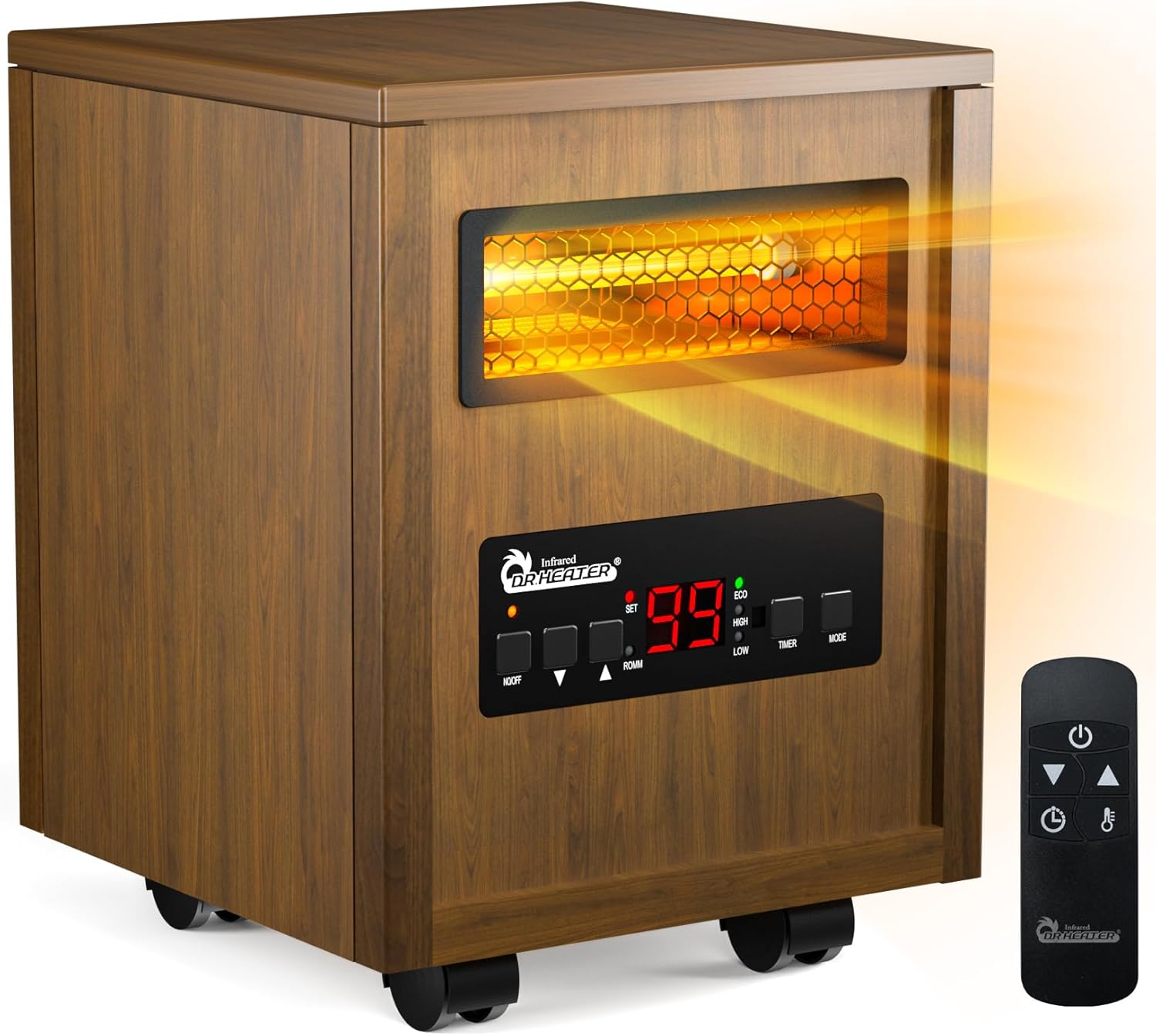
- Fast, even whole-room heating
- Quiet enough for sleep and work
- Remote and timer add convenience
- Easy to move with wheels
- No filter replacements needed
Cons
- Remote requires 2 AAA batteries not included
- 6-foot cord may limit placement options

Pros
- Heats up quickly with infrared technology
- Two power settings for flexibility
- Adjustable thermostat for comfort control
- Safety shutoff if tipped over
- Lightweight and easy to relocate
Cons
- No remote control included
- Fan may produce noticeable noise

Pros
- Quiet operation for peaceful sleep or work
- Adjustable thermostat from 50 to 90°F
- ECO mode reduces energy waste
- Safety features for worry-free use
- Stylish cabinet design with easy-roll wheels
Cons
- Requires 2 AAA batteries for remote (not included)
- Heavier than some portable heaters

Pros
- Dual heating for efficient warmth
- Built-in humidifier prevents dry air
- Oscillation distributes heat evenly
- Safety protections for kids and pets
- Remote and thermostat for convenience

Pros
- Heats people and objects directly
- Built-in humidifier reduces dry air
- Oscillation spreads heat evenly
- Remote control and timer included
- Safety features for kids and pets
Cons
- May be bulky for small spaces
- Limited to 1500W output
To choose the best infrared space heater for your situation, you need to consider several practical factors. Here are the key criteria that make a real difference in daily use.
Heating Technology: Quartz vs. Dual Heating
Most infrared heaters use quartz elements to produce heat. Some models, like those with “dual heating,” combine infrared quartz tubes with a secondary heat source (such as a PTC ceramic element) to warm up faster or cover more area. If you need quick, direct heat for a small room, a quartz-only unit works well. For larger spaces or whole-room heating, a dual heating system may distribute warmth more evenly.
Room Size Coverage
Manufacturers often specify a coverage area (e.g., up to 1,000 sq ft). However, real-world performance depends on insulation, ceiling height, and layout. A 1,500-watt heater typically covers around 400–600 sq ft. If you plan to use it as a primary heat source in a larger room, look for higher wattage or dual heating. For spot heating (e.g., at a desk or in a bedroom), a smaller personal unit is sufficient.
Noise Level
One of the main advantages of infrared heaters is that they operate quietly — no loud fan blowing air. Most are nearly silent, with only a faint hum from the internal thermostat cycling on and off. If you are sensitive to noise (e.g., for sleeping or working), an infrared heater is a good choice. Some models add an oscillation feature, which may produce a slight motor sound.
Safety Features
Essential safety features include tip-over protection, overheat protection, and a cool-touch exterior. Many models also have a child lock and a programmable timer. If you have pets or kids, look for heaters that automatically shut off if knocked over. Also consider the surface temperature of the heater — some stay cooler to the touch than others.
Portability and Placement
Most infrared heaters come with wheels or a carrying handle, making them easy to move between rooms. Compact models are designed for desktops or floors. If you plan to move the heater frequently, check the weight and wheel quality. Some models also include a remote control for convenience from across the room.
Energy Efficiency and Thermostat
Infrared heaters are generally more energy-efficient than resistance heaters because they heat objects directly, reducing heat loss. An adjustable thermostat allows you to set a target temperature, and an ECO mode can further reduce energy use by cycling the heater on and off. For zone heating (heating only the room you’re in), look for models with programmable timers and multiple heat settings.
Humidifier or Additional Features
Some infrared heaters include a built-in humidifier to combat dry air — a common complaint with any heater. If you live in a dry climate or find that heaters worsen your sinuses, this can be a valuable extra. Other features like oscillation, programmable thermostat, and LED display add convenience but may not be essential for everyone.
Why You Should Trust Us
Our recommendations are based on a careful comparison of available product specifications, listed features, practical usability factors, and documented customer feedback. We prioritize products that offer genuine value, reliability, and thoughtful design. We do not claim to have physically tested every heater, but we analyze what real buyers say about build quality, ease of use, and performance. Our goal is to help you make an informed decision based on what matters most for your home or office.
Final Thoughts
After reviewing 8 infrared space heaters, a few stand out for different needs. The DR. INFRARED HEATER DR-998 (listed twice in different colors) offers dual heating, oscillation, and a built-in humidifier, making it a versatile all-around choice for medium to large rooms. If you value energy efficiency with ECO mode and flexible temperature control, the Electric Heater with ECO Mode,6 Quartz (WEWARM) is a solid budget-friendly pick. For those who need a compact, affordable personal heater for a desk or small space, the 1500W Personal Space Heater with Adjustable (BLACK+DECKER) delivers reliable performance at the lowest price point.
Ultimately, the best infrared space heater depends on your room size, noise sensitivity, and desired features. For more winter warmth solutions, browse our Winter Essentials category.
Frequently Asked Questions
Do infrared space heaters use a lot of electricity?
Infrared heaters consume about the same electricity as other 1,500-watt electric heaters. However, because they heat objects directly, you may feel comfortable at a lower thermostat setting, which can reduce total energy use. Many models include ECO mode or programmable timers to further save energy.
Can I leave an infrared space heater on overnight?
Look for models with built-in safety features like tip-over and overheat protection. Many have a timer function that allows you to set it for a few hours before automatically shutting off. Always follow the manufacturer‘s guidelines and never leave a heater unattended in rooms where children or pets are present.
How long do infrared heaters last?
Infrared quartz tubes can last several thousand hours, often 5 to 10 years with normal use. The overall lifespan also depends on build quality and how often the heater is moved. Many reputable brands offer warranties of 1 to 3 years.
Are infrared heaters safe for pets?
Yes, because infrared heaters don‘t blow air or have exposed heating elements, they are generally safe around pets. However, the surface of some models can get hot, so choose one with a cool-touch exterior and place it where your pet cannot knock it over.
What size room does a 1,500-watt infrared heater heat?
A 1,500-watt infrared heater typically covers about 400 to 600 square feet in a well-insulated room. Actual coverage depends on ceiling height and room layout. For larger open spaces, you may need a dual heating model or two heaters.
Do infrared heaters create dry air like other heaters?
Infrared heaters do not blow air, so they don‘t circulate dust or dry out the air as much as forced-air heaters. Some models even include a built-in humidifier to add moisture, which can help with dry skin and sinuses.
Can I use an infrared space heater in a bathroom?
Only if the heater is specifically rated for bathroom use (e.g., UL-listed for damp locations). Most standard infrared space heaters are not waterproof and should be kept away from water sources. Always check the product specifications.
What is the difference between infrared and ceramic heaters?
Infrared heaters use quartz or halogen tubes to emit invisible infrared light that heats objects directly. Ceramic heaters use a ceramic element and a fan to blow warm air into the room. Infrared is quieter and more energy-efficient for zone heating, while ceramic heaters are often better for whole-room air warming.
Do infrared heaters need to be plugged into a dedicated outlet?
It‘s recommended to plug a 1,500-watt heater directly into a wall outlet (not an extension cord or power strip) to avoid overheating circuits. If you run multiple high-wattage devices on the same circuit, you may need a dedicated circuit.
Are infrared heaters good for large rooms?
They can be effective in large rooms, but you may need a model with dual heating or higher wattage. Some units cover up to 1,000 square feet, but for best results, use them as supplemental heat in large spaces rather than a primary heat source.
Buying Guide
Before choosing a product, compare the core features, comfort level, size, controls, warranty, and current retailer information. Product details can change, so always confirm the latest specifications on the retailer page before buying.
Key Features to Compare
- Massage type, intensity levels, and heat settings.
- Product size, fit, storage, and ease of use.
- Noise level, cleaning needs, and everyday convenience.
- Return policy, warranty, and current availability.